The Pump's Most Expensive Lie: What Octane Actually Measures (It's Not Quality)
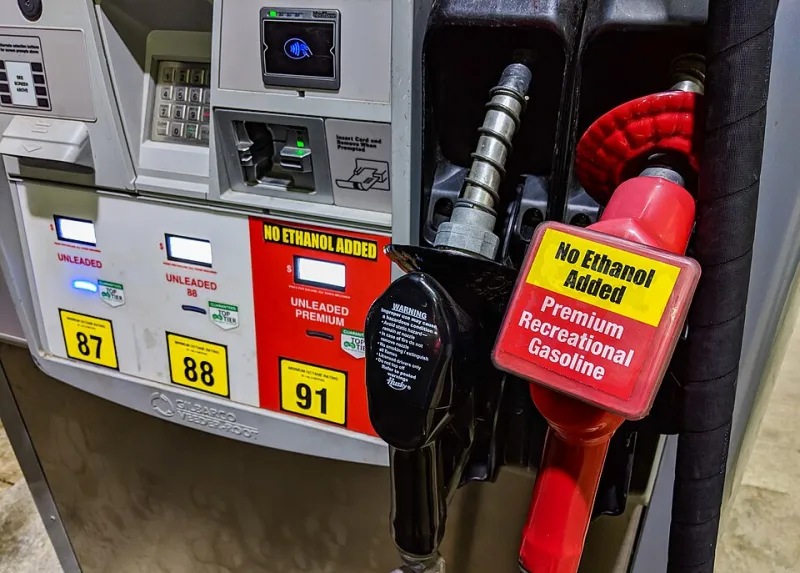
Photo: Tony Webster from Minneapolis, Minnesota, United States, CC BY 2.0, via Wikimedia Commons
Pull up to any gas station in America and you'll face the same quiet question, usually with a price gap of 40 to 60 cents per gallon between the bottom and the top. Plenty of drivers resolve it the same way: premium must be better. Better gas, cleaner engine, longer life — it's right there in the name.
It's an understandable leap. It's also the most expensive misunderstanding at the fuel pump.
Octane Is a Property, Not a Grade
The number on the button — 87, 89, 91, 93 — has nothing to do with energy content, cleanliness, or power. It measures a single characteristic: resistance to auto-ignition, often called "knock."
Here's the quick version of what happens inside your engine. Fuel is supposed to burn in a smooth, controlled wave, ignited by the spark plug. But under heat and pressure, gasoline can ignite on its own, out of sync with the piston. That premature detonation is knock — and if it happens a lot, it can damage an engine over time. Higher-octane fuel simply resists that spontaneous ignition better. That's the entire job it does.
A useful analogy: premium gas is like a higher-heat-rated frying pan. If your recipe calls for medium heat, a pan rated for searing temperatures gives you exactly nothing extra. You're paying for a tolerance you never use.
How the Confusion Took Root
The myth has deep roots. In the mid-20th century, octane ratings were a genuine marketing battleground — gas stations advertised "high-octane" the way modern brands advertise horsepower, and for the big engines of that era, the marketing was mostly accurate. Add in the word "premium" itself, which implies upgrade rather than property, and decades of word-of-mouth did the rest. Somewhere along the line, "higher number" became "better gas" in the popular imagination, and it never fully let go.
The Drivers Who Actually Need It
There's a real group of cars for which premium matters — but it's smaller than the number of people buying it. Engines with high compression ratios or turbochargers, many performance and luxury models among them, are engineered around higher-octane fuel. For those vehicles, the owner's manual will say "premium required," and using regular can cause knock, reduced output, or long-term wear.
The distinction that matters is between "required" and "recommended." If the manual says premium is required, buy it. If it says premium is "recommended" or merely "approved," you can usually run regular with little or no difference — the car's knock sensors will adjust. And if the manual says nothing at all, regular 87 is exactly what the engine was designed for.
One more myth worth clearing up while we're here: running premium in a regular car doesn't clean anything. It doesn't boost horsepower, improve mileage, or extend engine life. Every grade of gasoline sold in the US already carries the same detergent additives by federal requirement. Your engine will never know the difference — only your wallet will.
The Takeaway
Open your owner's manual before your next fill-up. If it demands premium, pay for it. If it doesn't, that 50-cent-per-gallon upgrade isn't an investment — it's a tip you're leaving for no one.