The AWD Badge on Your SUV Is a Traction Tool, Not a Winter Superpower
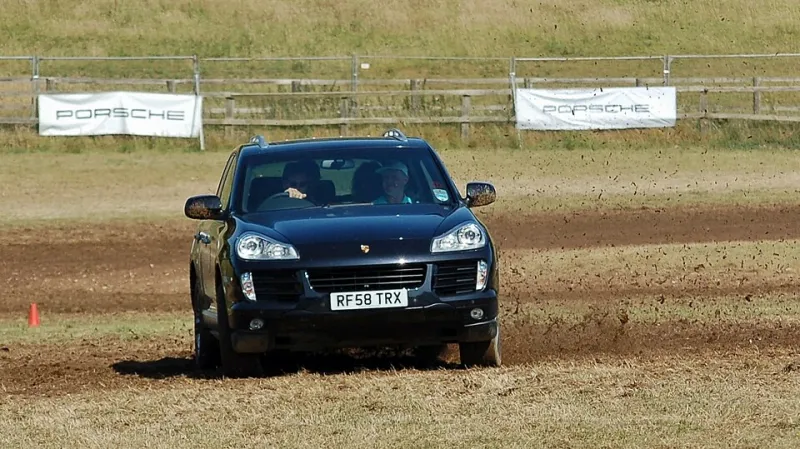
Photo: Bahnfrend, CC BY-SA 4.0, via Wikimedia Commons
The Story We Tell Ourselves Every November
Every fall, the same thing happens in dealership lots across the northern US. Buyers point to the AWD badge on a crossover, nod with confidence, and say some version of: "I got the all-wheel drive, so I'm good for winter."
It's an understandable conclusion. The marketing practically writes itself — rugged terrain, confident wheel spin, snow-dusted mountain roads. The implication is clear: this vehicle handles winter. You don't have to worry.
The problem is that AWD was never designed to do what most drivers assume it does. And every year, that gap between expectation and engineering reality ends up in a ditch.
What AWD Actually Does
All-wheel drive is a power delivery system. Its job is to send engine torque to multiple wheels simultaneously, rather than routing it all to just the front or rear axle. When one wheel loses grip during acceleration — say, pulling out of a snowy parking lot — AWD can redirect power to the wheels that still have traction. That's genuinely useful.
In practical terms, this means AWD helps you get moving on slippery surfaces. It can also improve stability during acceleration on wet or icy roads. For drivers who regularly navigate unplowed roads or steep driveways in winter, that's a real advantage.
But here's where the story gets complicated.
What AWD Cannot Do
AWD has no influence whatsoever on your ability to stop or steer on ice. None.
Braking is governed by your tires and your brake system — not your drivetrain. When you hit the brakes on a sheet of ice, every vehicle, whether it's a two-wheel-drive sedan or a full-time AWD truck, is subject to the same physics. The rubber meeting the road is what determines stopping distance, and AWD doesn't change that equation at all.
The same goes for cornering. Once you're already moving through a curve and the tires start to lose grip, AWD isn't helping you. In some cases, the added weight of AWD hardware can actually make things slightly worse, because a heavier vehicle carries more momentum into a slide.
The National Highway Traffic Safety Administration has documented this for years. Studies consistently show that AWD vehicles are not significantly safer than front-wheel-drive vehicles in winter crash statistics — partly because AWD drivers tend to take more risks.
Why the Myth Is So Persistent
The confidence AWD builds during acceleration is real, and it's exactly what creates the problem. You pull out of your snowy driveway without a hiccup. You merge onto the highway smoothly. You feel in control. So you drive a little faster. You follow a little closer. You enter that curve with a little more speed than you would in a regular car.
And then you need to brake, or you need to steer sharply, and the AWD badge on your dashboard does absolutely nothing for you.
Automakers know this, of course. If you read the owner's manual for any AWD vehicle, you'll find language that specifically notes AWD improves traction during acceleration but does not improve braking performance. That caveat just doesn't make it into the commercials.
The marketing has done its job so well that even experienced drivers conflate traction with total winter capability. They're not the same thing.
The Thing That Actually Makes a Difference
If you want real winter safety, the most impactful upgrade you can make has nothing to do with your drivetrain. It's your tires.
Winter tires — not all-season, actual winter tires — are engineered with a rubber compound that stays pliable in cold temperatures, plus tread patterns specifically designed to channel snow and bite into ice. A front-wheel-drive car on proper winter tires will outbrake and out-corner an AWD vehicle on all-season tires every single time. That's not opinion; it's a result that tire testing organizations have replicated consistently.
The irony is that most American buyers skip winter tires entirely because they bought AWD instead. It's a trade-off that feels like an upgrade but actually leaves you with less protection where it matters most.
How to Actually Use AWD Correctly
None of this means AWD is useless in winter. It means it needs to be understood correctly.
Use AWD's traction advantage to get moving safely from stops and to maintain stability at moderate speeds. But adjust your driving for the conditions as if the AWD weren't there — because in every situation that matters most, it isn't. Increase your following distance. Reduce your speed before corners, not during them. Give yourself room to stop.
If you live somewhere that gets real winter weather — Minnesota, Michigan, upstate New York, Colorado — seriously consider winter tires. Even if you have AWD. Especially if you have AWD, because that confidence is working against you.
The Takeaway
AWD is a useful feature. It's just not the winter safety blanket the badge implies. It helps you accelerate. It does nothing for braking or cornering on ice. The drivers who end up in winter accidents aren't always the ones in two-wheel-drive cars — they're often the ones in tall SUVs who trusted the badge a little too much and drove like the road conditions didn't apply to them.
The real story behind AWD isn't that it's a scam. It's that it solves one specific problem and got credit for solving all of them. Understanding where it stops working is what actually keeps you safe.