That Red Brake Light Isn't Warning You About Your Brakes — It's Telling You Something Else Entirely
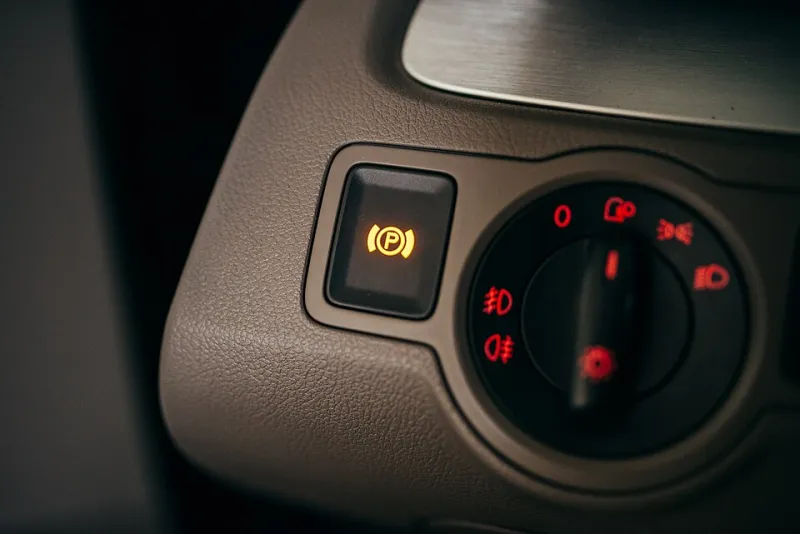
Photo: Shixart1985, CC BY 2.0, via Wikimedia Commons
The Light You Think You Understand
It happens at the worst possible moment. You're merging onto the highway, glancing at your dash, and there it is — a red symbol that says BRAKE, or shows an exclamation point inside a circle. Your stomach drops. Your mind races to repair bills, tow trucks, and everything that could go wrong at 65 miles per hour.
Here's the thing, though: that light probably isn't telling you your brakes are failing. In fact, it's almost certainly not monitoring your braking system the way you think it is. The name is misleading, the icon is vague, and the result is that millions of American drivers either panic unnecessarily or — far worse — dismiss a warning that actually does need attention.
Let's sort out what that light is really watching.
Two Completely Different Problems, One Light
In most vehicles, the brake warning light is triggered by one of two unrelated conditions.
The first is your parking brake. If you've engaged it — even partially, even accidentally — the light comes on. This is, by far, the most common reason drivers see it. You pull out of a parking spot, forget to fully release the handle or foot pedal, and the warning glows red the entire drive. The fix takes about two seconds.
The second trigger is your brake fluid level. Every vehicle has a reservoir under the hood that holds hydraulic brake fluid. When that fluid drops below a certain threshold — detected by a float sensor inside the reservoir — the same warning light activates. This one is more important, and more misunderstood.
Notice what's missing from both of those scenarios: your actual brake pads, rotors, calipers, or hydraulic lines. Those components have no direct sensor feeding that light. The warning system isn't sophisticated enough to tell you your pads are worn or a caliper is sticking. It's watching two much simpler data points — a float and a switch.
Why Low Brake Fluid Is More Complicated Than It Sounds
When most people hear "low brake fluid," they assume it's like being low on windshield washer fluid — just top it off and move on. But brake fluid doesn't really get consumed. It's a closed hydraulic system. If the level is dropping, something is happening to cause that drop, and that's the part worth understanding.
The most common reason brake fluid decreases over time is completely normal: your brake pads are wearing down. As the pads thin out, the calipers extend further to maintain contact with the rotors, which draws more fluid into the system. So a slightly low reservoir can actually just be a sign your pads are getting old — not that you have a leak.
But if the fluid level drops suddenly or significantly, that's a different conversation. That can indicate a leak somewhere in the system — a brake line, a caliper seal, the master cylinder. In that situation, driving is genuinely dangerous, because hydraulic pressure is what makes your brakes work. Lose enough fluid, and your pedal can go soft or even to the floor.
So the warning light isn't lying to you — it's just not giving you the full context. And that's where the confusion starts.
Why the Naming Has Always Been a Problem
Car manufacturers grouped these two triggers under one label decades ago, and the convention stuck. The idea was to create a simple, visible warning for anything brake-adjacent that a driver should check. The problem is that "brake warning" sounds like a brake failure warning, which sends people into unnecessary panic or — on the opposite end — causes them to assume it's minor and ignore it.
Neither response is quite right.
The parking brake scenario is almost always harmless. A lot of drivers have driven miles with it slightly engaged and nothing catastrophic happened (though it does wear the rear brakes faster, so it's worth avoiding). The fluid scenario sits somewhere in the middle — it could be benign wear-related drop, or it could be a leak that needs same-day attention.
The problem is that the light can't tell you which one it is. That's on you to figure out.
What You Should Actually Do When It Comes On
Step one: check whether your parking brake is fully released. This sounds almost too obvious, but it accounts for a large percentage of brake light calls to mechanics. Release it completely, drive a few feet, and see if the light goes off.
If it stays on, your next stop is the brake fluid reservoir — usually a translucent plastic container near the back of the engine bay, with MIN and MAX markings on the side. If the level is close to or below the MIN line, that tells you something. If it's at a normal level, there may be an electrical issue with the sensor itself.
If the fluid is low, don't just fill it and forget it. Pay attention to how quickly it dropped and whether your brake pedal feels different than usual — softer, lower, or requiring more pressure. Those are the signs that push the situation from "schedule an appointment" to "don't drive this car until someone looks at it."
The Takeaway
The brake warning light isn't a brake failure alarm. It's a two-trigger system watching your parking brake and fluid level — and it can't actually tell you much about the mechanical condition of your brakes themselves. When it comes on, start with the obvious (parking brake) and work toward the more serious (fluid level and why it's low). The light isn't broken, and it isn't lying — it's just working with a lot less information than its name implies.